Teaching
Do you live in Birmingham, Wolverhampton, or any other part of the Black Country, and are intrigued by the idea of learning to play the viola? Below are some questions that you might already be thinking, along with answers, but please feel free to contact me if you have any other queries about having lessons, or if you just want to ask anything that’s related to the viola!
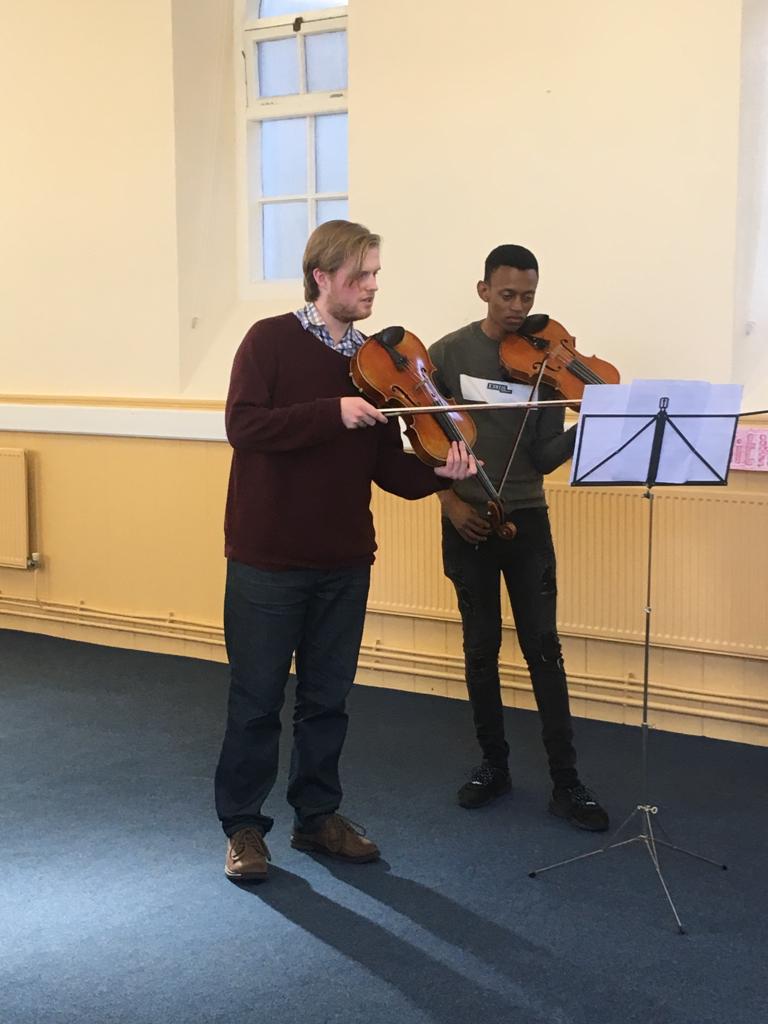
Why should I or my child learn to play the viola?
First, there are many benefits to playing any musical instrument! It stimulates the brain and helps to improve memorisation, and there are strong correlations between musical training and academic success. It can also enhance literacy and mathematical skills! And obviously, learning a musical instrument stimulates creativity, just like painting or writing a story.
Other benefits include improvement of listening skills, enhancing coordination, and learning about different cultures and history through music. Playing a musical instrument also expands ones social circle when joining a music group, no matter the size of the ensemble; and through this, it builds up leadership, teamwork, social and life skills.
As for learning to play the viola specifically… Violists always seem to be in short supply compared to the numerous violinists or cellists out there, so there are more opportunities for you to be involved with music groups or projects because you’d be in greater demand! And there is a healthy balance of playing some main melody material, but also more harmony or supporting material, so the violas can sit back and enjoy the music making (and have a chuckle at the violinists stressing about playing tricky, high-pitched music!).
There are also many different sizes of violas; so no matter how tall or short you are, there will be a viola that suits you. And perhaps you might prefer the viola’s timbre. While violins are great, they do get quite squeaky on their top E-string; but violas have a lower C-string instead, and so have a lovely, deeper and warmer tone.
What standard do you teach for?
I will teach anyone from beginners, up to the point they’re about to enter music college/conservatoire if one wishes to pursue playing the viola as a professional career. I’m also happy to teach anyone of any age, and I’m adaptable with my teaching approach depending on the standard and/or age of the student.
What is your teaching approach?
I’m very adaptable to the needs, age, or stage of learning a person is at. I won’t necessarily teach someone the same way as I might do with others, because everybody responds differently. However, one thing I will guarantee is to make sure sure we have covered every aspect of the music or a technical skill in careful detail, and not rushing over anything without consolidation. It is better to be patient with one’s learning, even if it takes weeks or months for that thing to finally click!
There will be a plan or structure for every student I have, so there is a clear path of progress in their playing. And I always aim to make lessons enjoyable, whether that’s through exercises and activities, learning a good mixture of classical and popular pieces, or exploring different and creative ways to figure out a tricky passage or technique.
For beginners or young students, aural music skills will be an important component of their learning. So not only will they be learning to play the viola, but they will also improve their singing, rhythmic, and other relevant skills. And music theory will be covered, especially for those wanting to take performance exams (although I’ll endeavor not to make it boring!).
What do you focus on in lessons? And how do you structure the lessons?
It very much depends on what’s being worked on specifically; but in general, I focus on getting every ounce of creativity out of my students, while also helping to build up their playing technique methodically, which will provide a solid foundation for their musical ideas. Both aspects compliment each other. While I will always encourage my students to focus on their musicality in performances, technique helps to execute those ideas to greater effect.
The exact structure or chosen material for each lesson varies. However, most lessons will include the pieces the student is learning. Lessons will always begin with a warm-up, which may include simple stretches, aural skill exercises, or scales. Other things that might be covered include studies to highlight specific technical challenges, and ensemble music the student is playing, which I’m happy to help with (including for orchestra music, chamber music, etc.). At the end of each lesson, we will review everything that has been covered, so that it’s clear for the student what they need to practice. I will also set targets to aim for the next lesson; and every so often we will review the long term goals in relation to the progress made.
How long are your lessons, and how often?
Generally, I like to give students one hour lessons every week, as I believe this is the optimal amount of time to learn and process information – not too long or too short. However, this can be adjusted if you have a different preference, especially if there are heavy work or educational commitments in your schedule. Lessons can be as short as 30 mins, or every two weeks rather than every week, etc.
How far are you willing to travel?
Most of my teaching will be based in Birmingham, Wolverhampton, and the surrounding Black Country area. But if there are convenient travel connections, I will consider travelling further out if you’d like lessons. If not viable for either party, then I will give you pointers to find a suitable teacher, so you’re not left in the dark!
Are you able to teach online?
I would always recommend in-person lessons first and foremost, if at all possible. However, I’m certainly more than happy to provide online teaching, especially if you live further afield (including other countries!). Also, if you’re local but one-off circumstances arise that you can’t turn up in-person, and you still want a lesson that week, I’m happy to facilitate it online. I typically use a video call program called ‘Zoom’, but I can use other apps such as WhatsApp or Skype.
Why do you teach?
After almost eight years of study at the Royal Birmingham Conservatoire – and about eight years learning violin or viola before that – I believe I should be sharing my knowledge to other people, especially to those who want to pick up a music instrument. I enjoy watching people develop other time with their chosen instrument and seeing the progress they make, especially so with my own students. And of course, I want more violists out there in the world! Therefore, I want to offer my services to introduce people to the viola, or to help take them to the next level with their playing.
 Peter Whitehead - Violist